Frizzy Hair in Summer? Here's How to Stop Humidity Ruining Your Hair
Summer should be the season of effortless, glossy hair. Instead, for many of us, it's the season of puffiness, flyaways, swelling, and styles that unravel the second we step outside.
According to Color Wow Chief Chemist Dr. Joe Cincotta, summer frizz isn't simply a styling problem, it's a moisture-management problem.
And once you understand what's actually happening to your hair, it's much easier to stop frizz.
Why Does Hair Get Frizzy in Summer?

Why Does Hair Feel More Frizzy in Summer than Winter?
Summer creates the perfect storm for frizz because several triggers are happening at the same time.


How to Control Frizzy Hair in Summer
The best way to fight frizz isn't to smooth it after it appears; it's to make hair less vulnerable to frizz in the first place.


 The more damaged and porous the cuticle becomes, the easier it is for humidity to penetrate the strand.

Why Good Hair Habits Aren't Always Enough
Even healthy, well-cared-for hair can struggle in high humidity.
Once moisture enters the hair shaft, the strand begins to swell, creating the puffiness, flyaways, and rough texture we associate with frizz.
That's why many traditional anti-frizz products only provide temporary results. Many creams, oils, and smoothing products help make hair look and feel smoother by coating the surface of the strand.
While that can be effective for managing dryness, static, and surface frizz, it doesn't necessarily stop atmospheric moisture from penetrating the hair in humid conditions.
For people whose biggest frizz trigger is summer humidity, a different approach is often needed.
Humidity-related frizz is often less of a styling problem and more of a barrier problem.
Preventing moisture from getting into the hair in the first place is usually far more effective than trying to smooth frizz after it appears.
The Best Humidity Fighters for Summer Hair

Which Dream Coat Is Right for You?


Don't Forget the Shine Factor

Dr. Joe's Summer Frizz Game Plan
If your hair struggles every summer, keep your routine simple:
-
Minimise friction when hair is wet
- Keep hair hydrated
- Protect against UV exposure and environmental stress
- Use humidity-resistant technology when styling
- Touch up flyaways instead of restyling everything
-
Add shine to help hair look smoother and healthier
The Bottom Line
If you've been wondering why your hair gets frizzy in summer, the answer comes down to one thing: moisture.
Humidity, heat, sweat, UV exposure, and environmental stress all work together to disrupt the hair cuticle and create frizz.
While healthy hair habits can make a significant difference, the most effective summer frizz routines combine prevention, protection, and targeted touch-ups.
Frequently Asked Questions
Why does my hair frizz even after using anti-frizz products?
Almost always one of three reasons:
- The product is a smoothing agent rather than a genuine cuticle sealer (different mechanism, insufficient in high humidity)
- The product was applied to dry hair after styling rather than to wet hair before styling
- The hair's porosity is high enough that atmospheric moisture is penetrating even through a surface coating.
A cuticle-sealing treatment applied before styling, activated with heat, is the most reliable solution.
Does humidity affect all hair types equally?
No. High-porosity hair (which includes most colour-treated, bleached, or chemically processed hair) is significantly more vulnerable to humidity-driven frizz than low-porosity hair.
Curl pattern also affects frizz: curly and coily hair is more susceptible because sebum (the scalp's natural moisturiser) cannot travel down a curved shaft the way it does a straight one, leaving the lengths more porous by default.
What is the best product to stop frizz in humidity?
The most effective category of product for true anti-humidity performance is a heat-activated cuticle sealer applied to wet hair before blow-drying.
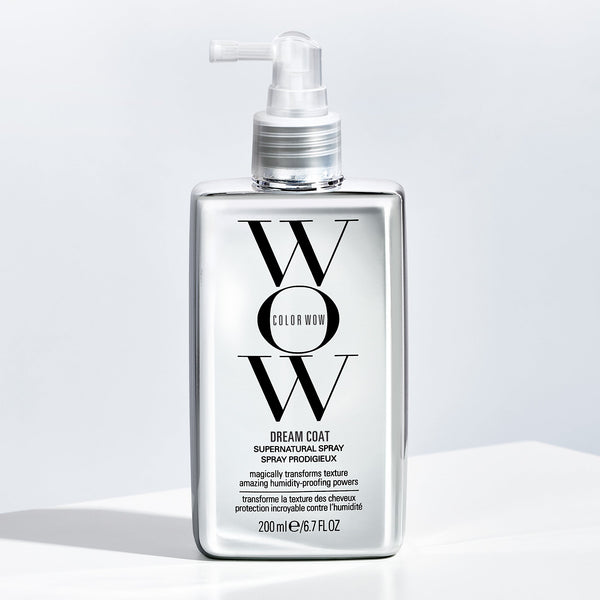
Dream Coat Supernatural Spray is specifically engineered for this — it is not a smoothing cream or a silicone coating, but a hydrolyzing treatment that compresses the cuticle under heat to create a genuine moisture barrier.
How long does anti-humidity protection last?
Dream Coat's protection lasts through 3–4 washes under normal conditions.
This means a Sunday application provides meaningful protection through most of the week, even with daily exposure to humidity.
Can I air-dry after applying Dream Coat?
Yes, but with reduced effectiveness.
Dream Coat's hydrolyzing technology is heat-activated — the blow-dryer is what triggers the cuticle compression and bonding that creates maximum humidity resistance.
Air-drying provides some benefit but significantly less than heat activation, particularly in high dew-point conditions.
Does straightening or flat ironing help with humidity frizz?
Temporarily. Flat ironing breaks and resets hydrogen bonds in a very straight configuration but, without a sealing barrier over the top, atmospheric moisture will begin re-breaking those bonds as soon as you step outside.
The iron sets the style; a cuticle sealer keeps it there. Both are needed in high humidity.
Why does my blowout look great inside but frizz the moment I go outside?
Because the hydrogen bonds in your hair reformed in their styled position inside but, without a cuticle seal over the top, atmospheric moisture (especially at high dew points) begins breaking and reforming them almost immediately upon outdoor exposure.
The transition from climate-controlled indoor air to outdoor summer humidity is exactly the moment a barrier product is supposed to intervene.
Is frizzy hair damaged hair?
Not necessarily. Naturally curly or high-porosity hair can be frizz-prone without being damaged.
However, damage — from chemical processing, heat, mechanical friction — does increase porosity and therefore increases frizz susceptibility.
Reducing damage over time (through gentler processing, consistent protective products, and regular mineral removal) reduces long-term frizz vulnerability.